Dijkstra's Shortest Path
Dijkstra’s algorithm is an algorithm for finding the shortest paths between nodes in a graph, which may represent, for example, road networks.
The algorithm exists in many variants; Dijkstra’s original variant found the shortest path between two nodes, but a more common variant fixes a single node as the “source” node and finds shortest paths from the source to all other nodes in the graph, producing a shortest-path tree.
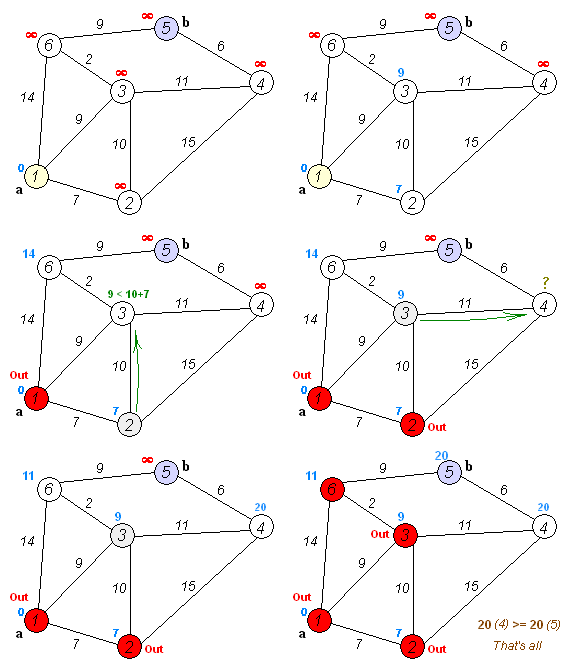
Dijkstra’s algorithm to find the shortest path between a and b.
It picks the unvisited vertex with the lowest distance,
calculates the distance through it to each unvisited neighbor,
and updates the neighbor’s distance if smaller. Mark visited
(set to red) when done with neighbors.
References
Implementations
-
1
# TODO: Implement in Python -
1
2
3
4
5
6
7
8
9
10
11
12
13
14
15
16
17
18
19
20
21
22
23
24
25
26
27
28
29
30
31
32
33
34
35
36
37
38
39
40
41
42
43
44
45
46
47
48
49
50
51
52
53
54
const G = Randomize.Graph({ N: 5, ratio: 1, directed: false, weighted: true });
const MAX_VALUE = Infinity;
const S = []; // S[end] returns the distance from start node to end node
for (let i = 0; i < G.length; i++) S[i] = MAX_VALUE;

function Dijkstra(start, end) {
  let minIndex;
  let minDistance;
  const D = []; // D[i] indicates whether the i-th node is discovered or not
  for (let i = 0; i < G.length; i++) D.push(false);
  S[start] = 0; // Starting node is at distance 0 from itself

  let k = G.length;
  while (k--) {
    // Finding a node with the shortest distance from S[minIndex]
    minDistance = MAX_VALUE;
    for (let i = 0; i < G.length; i++) {
      if (S[i] < minDistance && !D[i]) {
        minDistance = S[i];
        minIndex = i;
      }
    }
    if (minDistance === MAX_VALUE) break; // If there is no edge from current node, jump out of loop
    D[minIndex] = true;

    // For every unvisited neighbour of current node, we check
    // whether the path to it is shorter if going over the current node
    for (let i = 0; i < G.length; i++) {
      if (G[minIndex][i] && S[i] > S[minIndex] + G[minIndex][i]) {
        S[i] = S[minIndex] + G[minIndex][i];

      }
    }

  }

  if (S[end] === MAX_VALUE) {
    console.log(`there is no path from ${start} to ${end}`);
  } else {
    console.log(`the shortest path from ${start} to ${end} is ${S[end]}`);
  }

}

const s = Randomize.Integer({ min: 0, max: G.length - 1 }); // s = start node
let e; // e = end node
do {
  e = Randomize.Integer({ min: 0, max: G.length - 1 });
} while (s === e);

console.log(`finding the shortest path from ${s} to ${e}`);
Tracer.delay();

Dijkstra(s, e);